
Cool-season lawns, seeded on time
Hydroseeding in Minneapolis, MN
New lawns, construction ground and slopes covered in seed and mulch during the weeks Minnesota grass actually wants to grow.
- We walk the site with you before we price anything
- Itemized quotes: seed, mulch, prep and erosion control on separate lines
- Seed mixes chosen for your sun, shade and foot traffic
Seed, Mulch and a Narrow Window
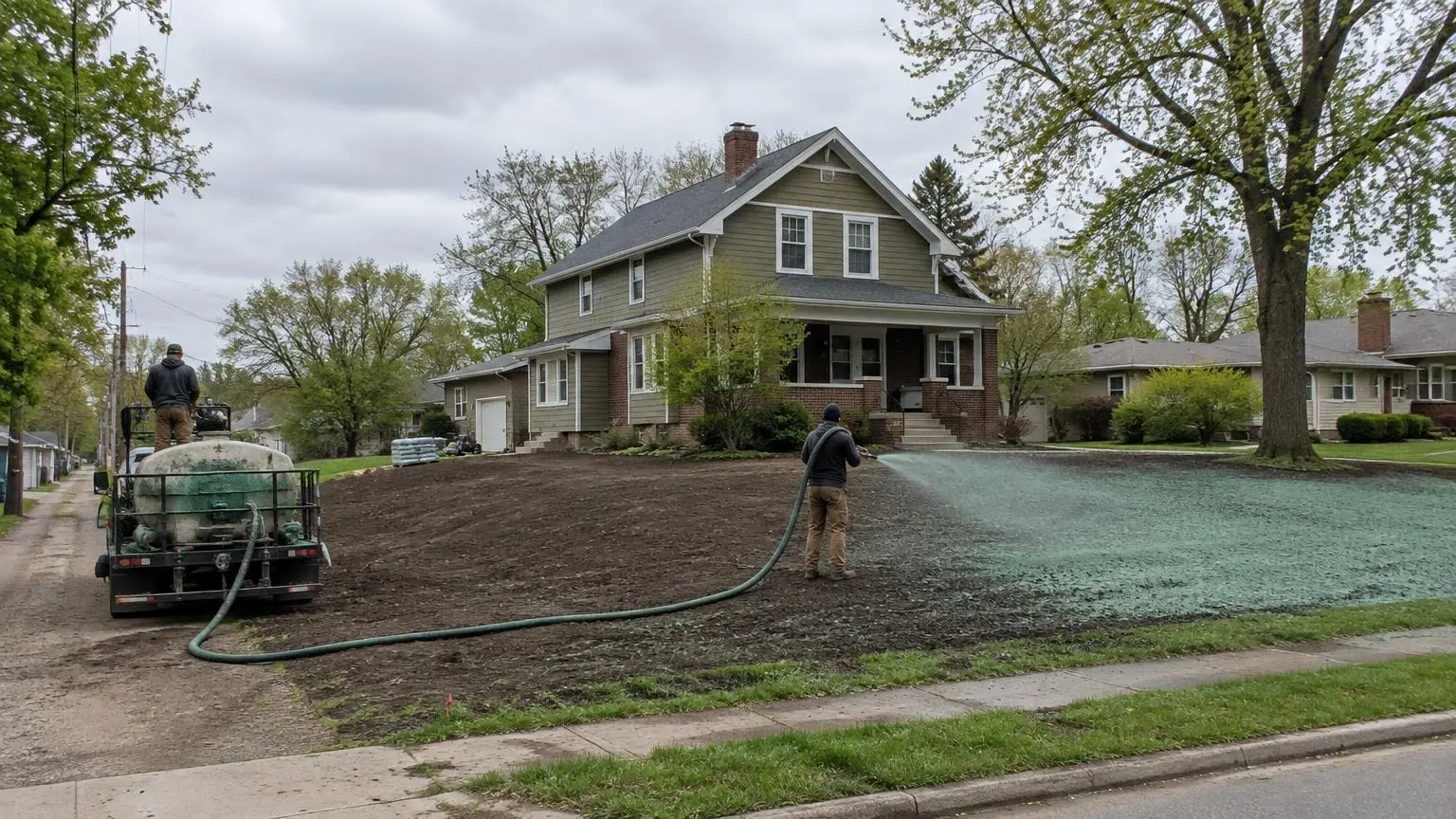
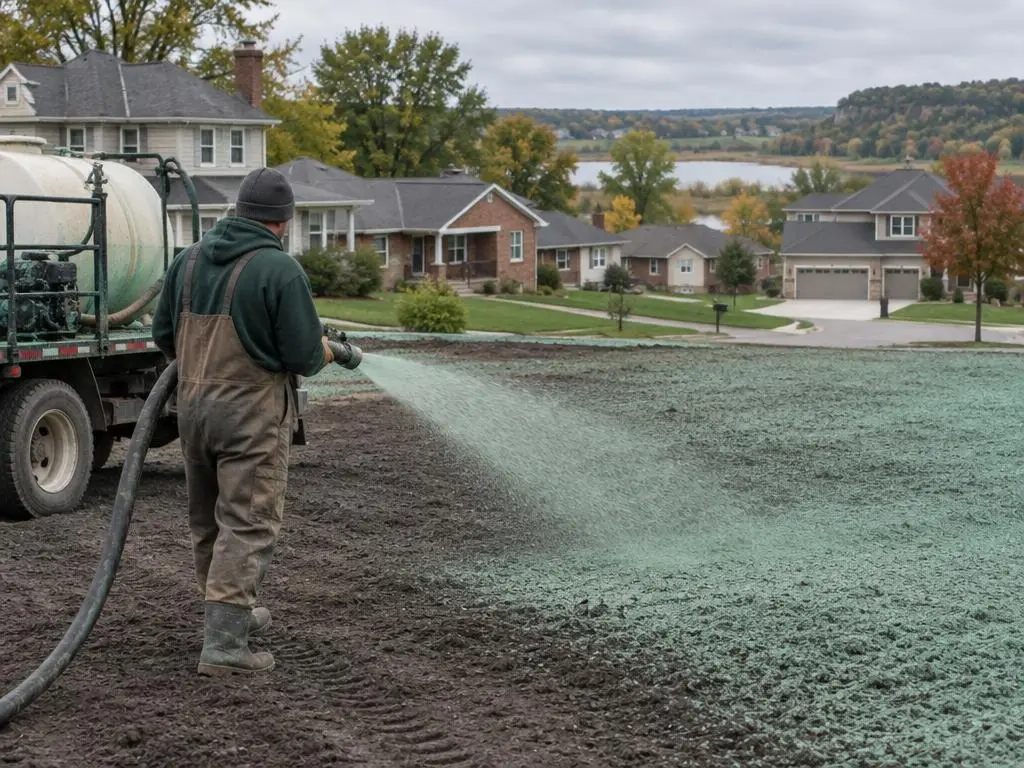
Hydroseeding in Minneapolis is a timing job as much as a seeding job. Elite Hydroseeding Minneapolis sprays a slurry of grass seed, wood-fiber mulch, starter fertilizer, tackifier and water onto prepared soil for homeowners, home builders and property managers across the city and the suburbs around it. Around that core work we lay erosion control blankets and hydromulch on slopes, put up silt fence and inlet protection, grade and spread topsoil, and overseed lawns that have thinned out. Most of what we do is aimed at one goal: getting bare ground covered with grass before a Minnesota winter, or a summer thunderstorm, gets to it first.
Sod, hydroseed or a bag of seed
The University of Minnesota Extension frames the choice simply: seeding costs less than sod but takes longer to give you a durable lawn, and sod costs more but covers the ground right away. Seeded lawns get a wider choice of grass species and build stronger roots over time, and they avoid the layer of foreign soil that comes with sod rolls and can cause rooting problems. Most sod grown in Minnesota is Kentucky bluegrass, so a shady yard that needs fine fescue is usually better off from seed. On price, HomeGuide's ranges are $0.12 to $0.35 a square foot for hydroseeding against $1 to $4 a square foot to lay sod.
Hydro seeding sits between sod and dry broadcast seed. University of Nebraska Extension notes that it costs a little more than dry seeding but generally less than sodding, and that hydroseeded grass usually comes up within 5 to 7 days, where dry seed tends to need two to three weeks. The mulch in the slurry is the reason. It shades the seed, holds water against it and keeps it from washing into the street. Kentucky bluegrass is still slow, and Extension says it can take 2 to 3 weeks to germinate, so a bluegrass-heavy mix will not look green in a week no matter how it was applied.
The seeding calendar here
Extension's advice for Minnesota is specific: the best time to seed is late summer, mid-August to mid-September. NOAA's 1991-2020 averages for the MSP airport station show why. August's daily mean is about 72 degrees and September's about 63, warm enough for quick germination but past the worst summer heat. By October the daily mean drops just under 50 and the month averages 0.8 inches of snow; November averages 6.8 inches. A lawn seeded in the late-summer window has six to eight weeks to root before the ground shuts down.
Spring is the second choice. April still averages 3.5 inches of snow, May warms to a daily mean near 60, and June is the wettest month of the year at about 4.6 inches. Spring seedings can work, especially for repairs, but they meet summer heat and crabgrass while they are young. Summer seedings are possible with steady irrigation, and we will tell you honestly what that will take. What we try to avoid is spraying in late October and hoping.
Two kinds of ground
The metro sits on glacial deposits, and lawns behave differently depending on which kind they grew on. On the outwash plains and valley trains, soils like the Waukegan series have a black silt loam surface about a foot thick, a brown silty layer below it, and then gravelly coarse sand starting 50 to 100 centimeters down. The USDA lists these soils as well drained, and their native cover was tall grass prairie: big bluestem, indiangrass and switchgrass. A new lawn on that kind of ground drinks water fast and dries quickly between waterings.
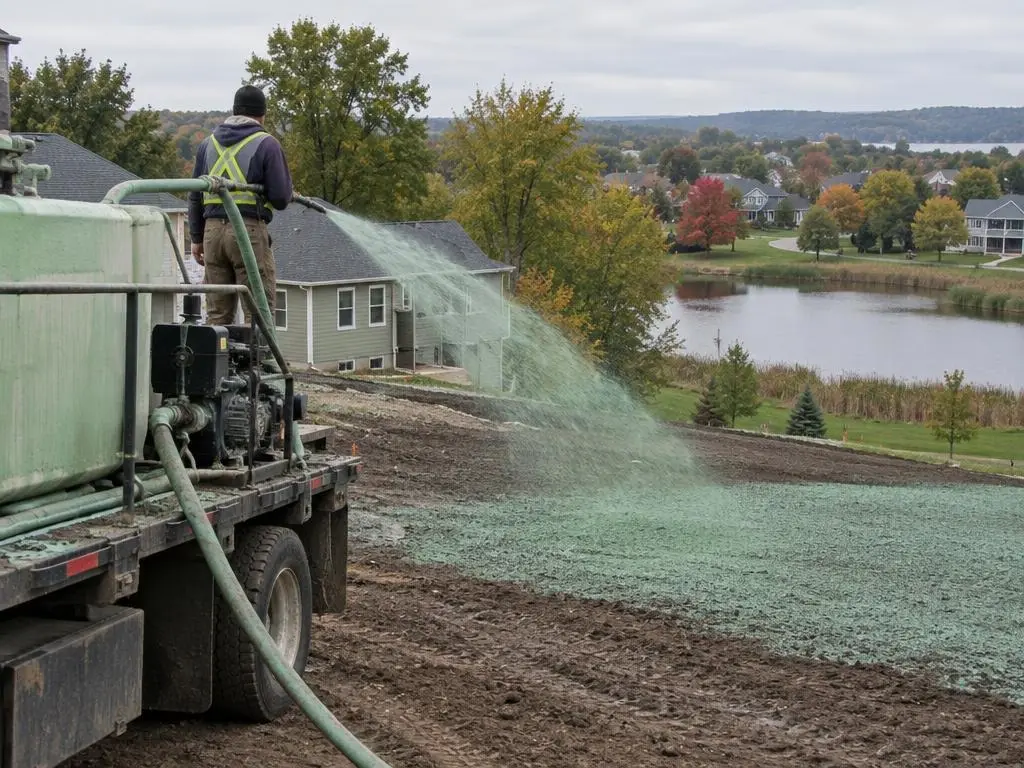
On the till plains and moraines, soils like the Lester series have a dark loam surface over a firm clay loam subsoil, roughly a quarter to a third clay by the USDA's figures, on slopes the USDA lists from 5 up to 70 percent. When a builder strips and grades a lot like that, the surface we are asked to seed is often that brown clay loam, not topsoil. Rain runs off it instead of soaking in, and the slurry needs tackifier, the right mulch rate and sometimes a blanket on the steeper sections to stay put.
Rules that come with bare soil in the city
Minneapolis regulates erosion under Chapter 52 of its ordinances. Any land disturbance over 500 square feet, or 5 cubic yards, needs an erosion and sediment control permit, and that explicitly includes utility excavations and residential or commercial demolition. Over 5,000 square feet, the city wants an approved erosion control plan before it issues the permit. Sites over an acre also need a stormwater management plan under Chapter 54. A teardown and rebuild on a city lot can easily cross the first threshold, which is why we often seed lots where silt fence and inlet protection are already part of the permit.
The city's fertilizer ordinance, Chapter 55, restricts phosphorus because it feeds algae in the lakes and the Mississippi. It makes an exception for the first growing season of a new lawn, or when a soil test shows a need. That is the rule we follow with starter fertilizer. On established lawns being overseeded, we use phosphorus only when a soil test calls for it, and the city notes that Minneapolis soils are typically higher in phosphorus already.
What the first weeks look like
Extension recommends soaking new seed in to a depth of 4 to 6 inches and then switching to light, frequent watering, up to 3 or 4 times a day, cutting back during rain and after germination as roots go deeper. Hydroseed mulch helps the surface stay damp between those sessions, but it does not replace them. HomeGuide puts the first mowing at 4 to 6 weeks after seeding. Extension also warns that it takes nearly a full season for a seeded lawn to become mature and durable, and that weeds have more of an opening than they do in sod. We leave you a watering plan the day we spray, written for the mix we used and the month we used it in.
Picking the seed
The Extension list for Minnesota lawns is Kentucky bluegrass, fine fescues, turf-type tall fescue and some perennial ryegrass varieties. Sunny areas that take a lot of wear do best with improved bluegrasses, ryegrass or tall fescue. Shade calls for fine fescue mixes, and Extension's low-input mix for a sunny yard is about 50 to 60 percent common Kentucky bluegrass with 40 to 50 percent fine fescue. Older city lots with big boulevard trees often need two mixes: one for the open front yard and one for the shaded strip along the side of the house. We match the mix to the spot, not to whatever is in the truck.
What a job looks like
- We walk the site, measure the area and look at slope, shade and drainage
- Your written quote breaks out prep, seed, mulch and fertilizer as separate lines
- Rough grade is checked, topsoil is added where needed, and the surface is raked and firmed
- Erosion control goes in first on slopes or near storm drains
- We spray the slurry in overlapping passes and keep it off walks, siding and drives
- You get the watering plan, and we answer questions through the first mowing
Cities on Our Route
We cover Minneapolis and the suburbs that ring it. West of the city we work in Plymouth, Maple Grove, Minnetonka, Edina, Eden Prairie and Chanhassen, where lake lots, wooded slopes and teardowns are common. To the south, Bloomington, Burnsville, Savage, Shakopee, Prior Lake, Chaska, Apple Valley, Eagan, Lakeville and Rosemount range from river bluffs above the Minnesota River to newer subdivisions on former farmland. North of the city we cover Brooklyn Park, Rogers, Blaine and Lino Lakes, where sandy ground and wetlands shape how a lawn gets established. East of the river we work in Woodbury and Cottage Grove. Each city has its own page with the local details that matter for seeding there.
- Hydroseeding in Minneapolis, MN
- Hydroseeding in Plymouth, MN
- Hydroseeding in Maple Grove, MN
- Hydroseeding in Eden Prairie, MN
- Hydroseeding in Bloomington, MN
- Hydroseeding in Edina, MN
- Hydroseeding in Minnetonka, MN
- Hydroseeding in Woodbury, MN
- Hydroseeding in Blaine, MN
- Hydroseeding in Lakeville, MN
- Hydroseeding in Shakopee, MN
- Hydroseeding in Chanhassen, MN
- Hydroseeding in Prior Lake, MN
- Hydroseeding in Apple Valley, MN
- Hydroseeding in Burnsville, MN
- Hydroseeding in Eagan, MN
- Hydroseeding in Savage, MN
- Hydroseeding in Chaska, MN
- Hydroseeding in Rosemount, MN
- Hydroseeding in Cottage Grove, MN
- Hydroseeding in Brooklyn Park, MN
- Hydroseeding in Rogers, MN
- Hydroseeding in Lino Lakes, MN
Why Homeowners Call Elite Hydroseeding Minneapolis
Seeding on the calendar
We book late-summer seedings early and tell you up front when spring or a dormant-season blanket makes more sense.
Quotes you can read
Prep, seed, mulch, fertilizer, blankets and silt fence each get their own line, so nothing is buried in a lump sum.
City rules in mind
We know the Minneapolis 500 square foot erosion permit threshold and the phosphorus exception for new lawns.
Mixes for the spot
Sun, shade and traffic each get the grass the University of Minnesota Extension recommends for them.
Common Questions
How much does hydroseeding normally cost around Minneapolis?
Depending on which national guide you read, it runs about $0.06 to $0.35 a square foot. HomeGuide's range for a lawn of 5,000 square feet is roughly $1,000 to $1,750, and it notes that most companies set a minimum job fee of $300 to $500 or more. Grading, topsoil and slopes push the total up, so your yard's quote follows a measurement.
Which month is right for hydroseeding in Minneapolis?
Mid-August to mid-September, per the University of Minnesota Extension. Early spring is the next best for repairs and overseeding. Later in fall, the grass has too little time to root before the ground freezes.
What are the disadvantages of hydroseeding?
It is not an instant lawn. You water lightly several times a day for the first weeks, you stay off it until it is established, and weeds have more of a chance than in sod. Extension says a seeded lawn takes nearly a full season to mature.
Can I hydroseed my own lawn?
Small areas, yes, with a pump sprayer kit or a rented machine. The hard parts are getting the seed and mulch rates even across the yard and preparing the soil properly. For a whole yard, a slope or a lot that needs a city erosion permit, a crew with a full-size machine is usually faster and more consistent.
Does Minneapolis want a permit before I regrade and reseed?
If the work disturbs more than 500 square feet or 5 cubic yards of soil, the city requires an erosion and sediment control permit. Over 5,000 square feet, an approved erosion control plan is required first. We can tell you during the site walk whether your project is likely to cross those lines.
Can a new lawn get phosphorus fertilizer in Minneapolis?
Yes. The city's fertilizer ordinance limits phosphorus but allows it during the first growing season of a new lawn, or when a soil test shows a need. Our starter fertilizer follows that rule.
Is hydroseed or sod better for a steep yard?
Extension notes sod gives immediate cover on slopes and erosion-prone areas, staked in place across the slope. Hydroseed works on slopes too when it goes over a blanket or with extra tackifier and mulch. We look at the grade and the runoff before recommending one.
How soon can we mow and use the lawn?
HomeGuide puts the first mowing at about 4 to 6 weeks after seeding. Keep foot traffic, pets and play off it until then, and expect it to toughen up over the following season.
What We Seed, Protect and Prepare
Six lines of work that scale from one city backyard up to the last bare lots in a new subdivision.
Residential Lawn Hydroseeding
A hydroseed lawn for new homes, teardown rebuilds and yards starting over from bare soil.
Learn more →Builder & Commercial Hydroseeding
Hydroseeding services for home builders, commercial sites, ponds, boulevards and multi-acre ground.
Learn more →Slope Stabilization & Erosion Blankets
Blankets, hydromulch and bonded fiber matrix to hold slopes, swales and lakeshore banks against erosion.
Learn more →Silt Fence & Sediment Control
Silt fence installation, inlet protection and sediment barriers around the edge of a site, set up for permits and inspections.
Learn more →Yard Grading & Topsoil Prep
Fine grading, regrading, topsoil spreading and other dirt work to get a yard ready for seed.
Learn more →Overseeding & Lawn Renovation
Overseeding, patch repair and complete renovation for lawns that have gone thin, bare or weedy.
Learn more →Book a Site Walk Before the Window Closes
Tell us about the yard or the lot, and we will come measure and quote it.